In international business transactions, it is common for contracts to specify which jurisdiction’s laws will govern the agreement. Surprisingly, many cross-border contracts between companies located outside the United States choose New York law as the governing legal framework.
From multinational financing agreements to complex commercial partnerships, New York law has become one of the most widely used legal systems for international contracts. Businesses around the world often rely on it when structuring agreements that involve multiple jurisdictions.
The widespread use of New York law in international commercial contracts is well documented. A study examining governing-law clauses in contracts filed with the U.S. Securities and Exchange Commission found that nearly half selected New York law, far more than any other U.S. jurisdiction. Legal scholars frequently observe that New York law and English law dominate international business transactions, reflecting their extensive commercial case law and global reputation for predictability and enforceability.
New York as a Global Legal and Financial Center
New York has long been one of the world’s leading financial and commercial hubs. Major banks, investment firms, multinational corporations, and international law firms operate in the city. Because so many global financial transactions are structured through New York, its legal framework has become deeply embedded in international commerce.
Large cross-border transactions, including syndicated loans, mergers and acquisitions, and international trade agreements, are frequently drafted under New York law. Companies involved in these transactions often require precise multilingual documentation, which is why many international businesses rely on professional New York translation services when preparing contracts, regulatory filings, and other legal materials used across multiple jurisdictions.
Predictability and Established Case Law
One of the key reasons international companies choose New York law is its predictability. New York courts have produced a vast body of commercial case law over many decades. This extensive legal precedent helps lawyers and businesses understand how contractual disputes are likely to be interpreted.
For companies entering complex international agreements, predictability reduces legal uncertainty and risk.
Experienced Courts for Complex Commercial Disputes
New York courts, particularly those handling commercial litigation, have extensive experience resolving complex business disputes. Judges in these courts regularly deal with sophisticated financial transactions and international legal matters.
One reason New York law is widely chosen for international contracts is the experience of its courts in resolving complex commercial disputes. In particular, the Commercial Division of the Supreme Court of the State of New York regularly handles high-value international litigation involving financial institutions, multinational corporations, and cross-border transactions. The division was created specifically to deal with sophisticated commercial matters such as securities disputes, banking litigation, corporate governance conflicts, and international contract enforcement. Over the years, New York courts have issued influential decisions in cases involving global financial markets, including litigation arising from the collapse of Lehman Brothers, disputes involving sovereign debt issued by the government of Argentina, and numerous cross-border banking cases heard in the United States District Court for the Southern District of New York. These courts’ long experience with international finance and commercial disputes contributes to the predictability and credibility that make New York law attractive for global business agreements.
This experience gives global companies confidence that disputes will be handled by courts familiar with the realities of international commerce.
Neutral Jurisdiction for International Agreements
In transactions involving companies from different countries, selecting a neutral legal jurisdiction is often important. New York law is frequently viewed as a balanced and internationally respected legal framework that neither party controls.
This neutrality helps facilitate agreements between businesses operating in different regions of the world.
Enforceability of Judgments
Another advantage of New York law is the strong reputation of its judicial system. Court decisions issued in New York are widely respected and often enforceable across many jurisdictions.
This reliability makes New York law attractive for international agreements where enforcement of contractual obligations is a critical concern.
Why Language Accuracy Matters in International Contracts
When international agreements involve parties in different countries, contract documentation may need to be prepared or reviewed in multiple languages. Accurate legal translation becomes essential to ensure that obligations, rights, and contractual terms are interpreted consistently across jurisdictions.
Even small differences in wording can alter the legal meaning of a clause, particularly in complex commercial agreements.
Why Many International Contracts Choose New York Law
The infographic below summarizes several reasons why New York law continues to be widely used in international commercial agreements.
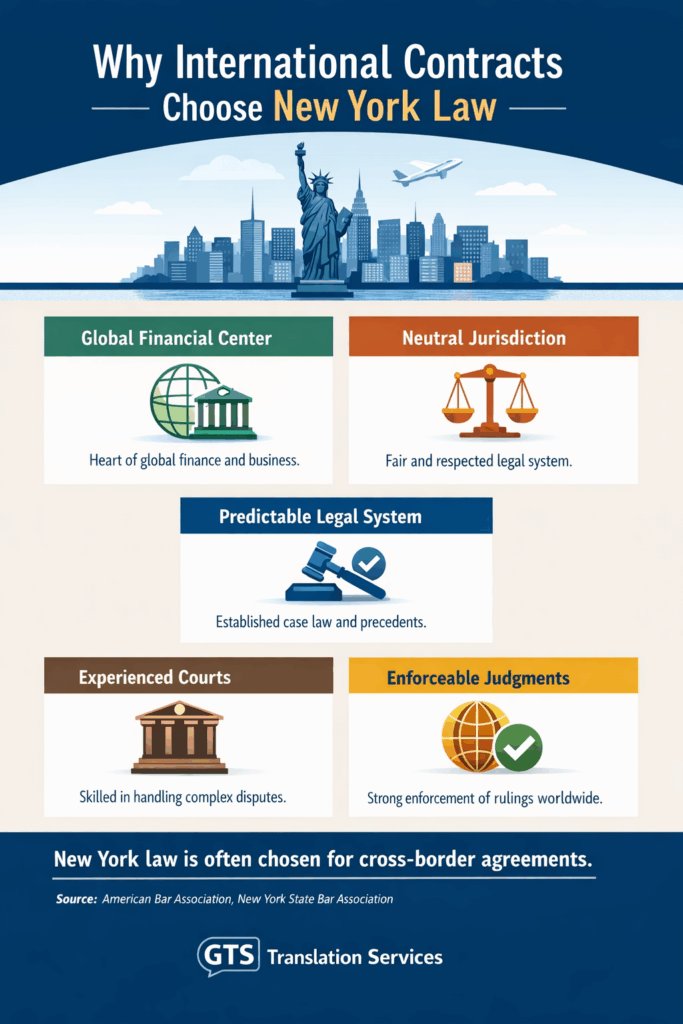
Source: American Bar Association, New York State Bar Association
The Role of Legal Translation in Cross-Border Agreements
For companies operating internationally, contracts, regulatory filings, financial documentation, and litigation materials often need to be translated accurately for use by lawyers, regulators, or courts in different jurisdictions.
Professional legal translation ensures that complex contractual language maintains the same meaning across languages and legal systems.
Learn more about our legal translation services and how GTS supports law firms and multinational companies involved in cross-border transactions.