Healthcare & Legal Localization Case Study
Multilingual Patient Consent in Minnesota: A Healthcare Translation Case Study
Navigating Medical, Financial, and Legal Terminology Across 6 Languages for Regional Clinic Compliance
Executive Summary & Key Outcomes
- Client: Regional Healthcare Provider in Minnesota
- Provider: GTS Translation Services
- Target Languages (6): Spanish (Latin America), Hmong, Somali, Vietnamese, Russian, Chinese (Traditional)
- Core Challenge: Preserving strict legal/administrative meaning (HIPAA privacy, billing authorization, consent scope) while maintaining clear readability for non-English-proficient patients.
- Key Solutions Implemented: Controlled medical/legal terminology review, human translation workflows, and cross-language quality assurance tailored to Minnesota’s local demographic needs.
Project At A Glance
| Project Parameter | Execution Details |
|---|---|
| Document Type | Patient Consent Form (Treatment, Billing, PHI Privacy, Disclosures) |
| Target Demographics | Minnesota’s key immigrant & refugee populations (Hmong, Somali, Spanish, East Asian, Eastern European) |
| Compliance Standards | Healthcare legal precision, HIPAA privacy terms, assignment of benefits, electronic communication rights |
| Workflow Methodology | Specialized medical/legal human translation, terminology control, and unified QA review |
Multilingual Communities in Minnesota’s Healthcare Landscape
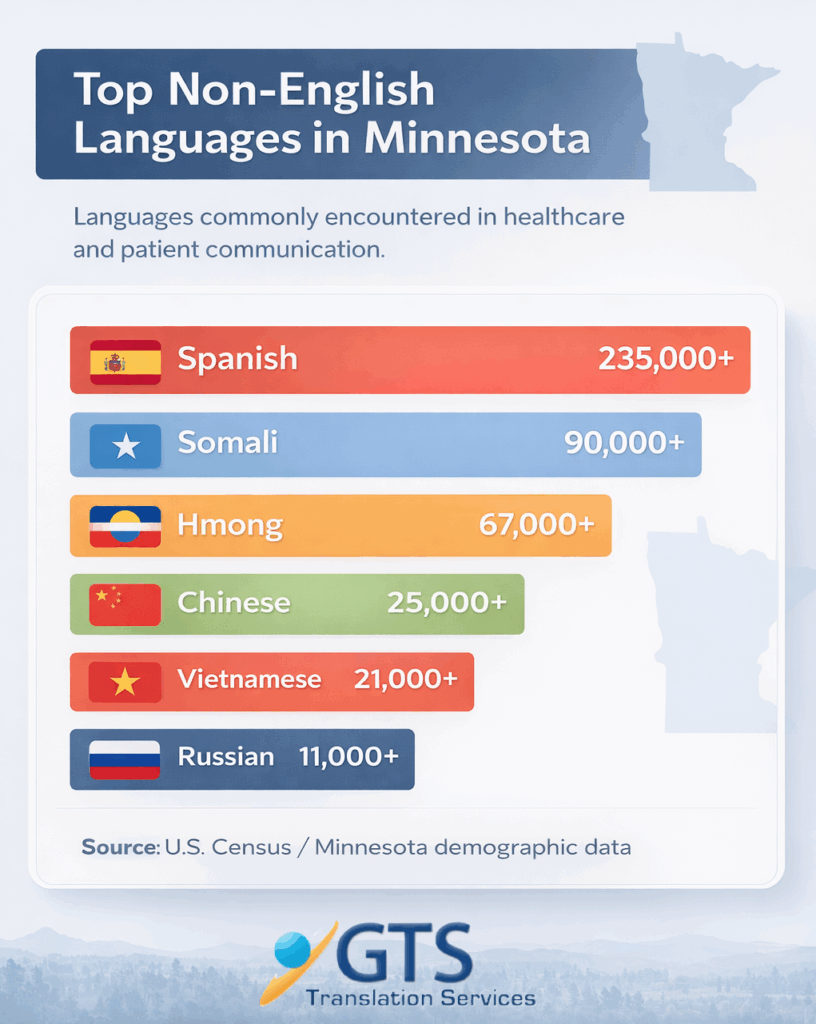
Since the late 20th century, Minnesota has welcomed diverse immigrant and refugee populations, establishing a large Hmong population, one of the largest Somali communities in the U.S., and growing Spanish, Vietnamese, Russian, and Chinese-speaking communities. For healthcare providers, multilingual materials are essential for daily clinical operations and informed patient consent.
Why Patient Consent Forms Require Special Care
A patient consent form intersects medical treatment, legal responsibility, and administrative policy. The source document in this project contained crucial provisions regarding:
- Authorization for medical treatment and clinical care
- Assignment of insurance benefits and financial responsibility
- Protected Health Information (PHI) privacy practices and disclosure rules
- Prescription refill, missed appointment, and electronic notification policies
The primary risk in patient consent translation is mistranslating complex administrative terms into awkward, misleading, or overly literal phrasing that compromises informed consent or creates legal exposure for the clinic.
Terminology Control Across 6 Languages
Translating legal-medical concepts requires balancing strict accuracy with patient readability. Rather than utilizing unverified machine translation, GTS implemented a human-in-the-loop workflow tailored for high-stakes healthcare documentation.
Quality Assurance Steps
- Specialized Translator Selection: Linguists experienced in U.S. healthcare, legal compliance, and medical terminology.
- Centralized Terminology Review: Standardizing core concepts (e.g., assignment of benefits, protected health information) across all 6 target languages.
- Readability & Cultural Alignment: Adapting complex U.S. administrative concepts into clear, natural phrasing for diverse patient backgrounds.
- Unified Quality Review: Ensuring consistent tone, structure, and quality standards across every language version.
Why Quality Healthcare Translation Matters
Providing clear, professionally translated intake and consent documents reduces point-of-care confusion, builds patient trust, and supports compliance. Accurate translations ensure patients fully understand their rights, payment obligations, and treatment authorizations before care begins.