Multilingual Patient Consent in Minnesota: A Healthcare Translation Case Study
Clear patient communication is a core part of quality healthcare. When a regional healthcare provider in Minnesota needed a patient consent form translated into six languages, the project was not simply about replacing English words with foreign-language text. It was about making sure patients could understand important medical, financial, and privacy-related information in their own language—and that the translated materials would reflect the seriousness of a healthcare consent document.
At GTS Translation Services, we regularly work on medical translation projects where accuracy, consistency, and clarity matter. This Minnesota clinic project is a good example of why patient-facing healthcare translation requires more than speed alone.
The Project: Patient Consent Translation in Six Languages
The clinic needed its patient consent form translated from English into the following languages:
- Chinese (Traditional)
- Hmong
- Russian
- Somali
- Spanish (Latin America)
- Vietnamese
For healthcare providers operating in diverse communities, ensuring accurate and compliant multilingual documentation is critical—especially when it comes to patient consent. This is where professional legal translation services Minnesota play an essential role in reducing risk and ensuring clarity across languages.
Multilingual Communities in Minnesota’s Healthcare Landscape
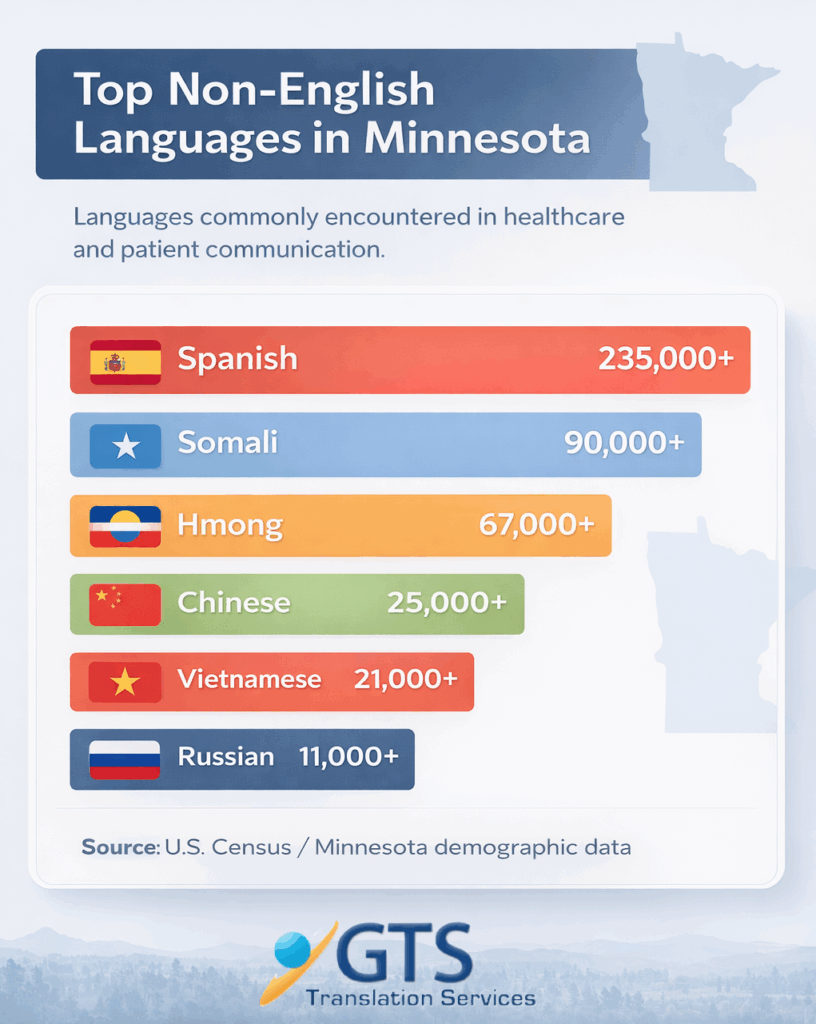
This language mix reflects Minnesota’s unique demographic profile. Since the late 20th century, the state has welcomed diverse immigrant and refugee communities, including a large Hmong population following the Vietnam War and one of the largest Somali communities in the United States. Spanish, Vietnamese, Russian, and Chinese-speaking populations have also grown steadily across the region.
For healthcare providers, this diversity creates a practical need for multilingual communication. Clinics are not simply translating documents for convenience—they are supporting patient understanding in environments where multiple languages are part of everyday clinical operations.

Why Patient Consent Forms Require Special Care
A patient consent form may look straightforward at first glance, but it contains several layers of meaning. In this case, the document included not only authorization for treatment, but also language relating to billing, insurance, privacy practices, prescription refills, missed appointments, electronic notifications, and authorization to discuss protected health information.
That creates a translation challenge. The text must be understandable to the patient, but it must also preserve the legal and administrative meaning of the source document. A mistranslation in a patient consent form can create confusion around payment obligations, privacy rights, appointment rules, or the scope of treatment authorization.
In other words, this is not routine marketing content. It is patient-facing healthcare documentation that needs to be translated with precision.
The Real Challenge Was Not Just Language—It Was Terminology
Projects like this highlight why medical translation for clinics is rarely a simple one-step process. Different languages present different challenges. Some require careful handling of legal-medical terminology. Others require special attention to tone, readability, or the way U.S. healthcare concepts are expressed for patients from different linguistic backgrounds.
In this project, terms relating to consent, assignment of benefits, privacy practices, billing authorization, protected health information, and electronic communication all required close review. These are exactly the kinds of terms that can become awkward, imprecise, or misleading if handled too literally.
That is why a controlled workflow matters. In patient consent translation, the goal is not just to produce text in another language. The goal is to produce a document that reads naturally, preserves the intended meaning, and fits the expectations of a formal healthcare setting.
Why This Matters for Healthcare Providers in Minnesota
Minnesota healthcare providers often serve multilingual patient populations. In that environment, language access is not a side issue. It is part of patient communication, patient trust, and day-to-day operations.
When clinics provide translated intake and consent materials, they help reduce confusion at the point of care. They also create a more professional experience for patients who may feel more comfortable reviewing key information in their primary language.
For documents such as patient consent forms, privacy notices, intake forms, discharge instructions, and medical questionnaires, translation quality matters because these are not documents patients simply glance at. They often contain information that affects treatment decisions, financial responsibility, and the patient’s understanding of how the clinic operates.
Six Languages, One Standard of Quality
One of the most important parts of a multilingual healthcare translation project is maintaining consistency across languages. A clinic does not want one version to sound formal and clear, while another contains awkward wording or unclear terminology. The standard needs to remain high across all target languages.
That is especially important when a single form is being translated into multiple languages for use within the same organization. Consistency in tone, terminology, and structure helps the clinic maintain a more unified patient communication process.
At GTS, projects like this are handled with professional human translators and review workflows designed for high-stakes content. Technology can support file handling and terminology consistency, but patient consent materials still require careful human review—particularly where medical, legal, and administrative concepts overlap.
Medical Translation Is Not Just About Compliance
There is also a broader point here. Clinics do not translate documents only because they are trying to “check a box.” They do it because patient understanding matters. A well-translated consent form helps patients understand what they are agreeing to, what their responsibilities are, and how the clinic may use or disclose relevant information in the course of care and billing.
That kind of clarity supports better communication and a better patient experience. It also reflects well on the provider itself.
Translation for Hmong, Somali, Spanish, Vietnamese, Russian, and Chinese in Minnesota
This project also reflects something important about healthcare translation demand in Minnesota: some of the most important language needs are highly local. A clinic serving patients in Minnesota may regularly need Hmong translation, Somali translation, Spanish translation, Vietnamese translation, Russian translation, and Chinese translation for patient-facing documents.
That is one reason generic, one-size-fits-all translation workflows often fall short. Local patient populations, document purpose, and healthcare context all matter. A patient consent form is not the place for vague wording, inconsistent terminology, or raw machine output that has not been carefully reviewed.
Conclusion
This six-language patient consent project shows what medical translation for clinics really involves. It is not just a matter of converting a document into multiple languages. It is a matter of helping a healthcare provider communicate clearly and responsibly with patients across a multilingual community.
For healthcare organizations in Minnesota, that need is very real. And for documents like patient consent forms, translation quality has a direct impact on clarity, professionalism, and patient understanding.
GTS Translation Services provides professional medical translation services for healthcare providers, clinics, hospitals, and medical organizations in more than 100 languages. We translate patient-facing documents with an emphasis on accuracy, consistency, and clear communication.