Legal Translation Demand by the Numbers: What U.S. Law Firms Actually Need Translated (2026)
Legal translation in the United States is driven less by abstract language demand than by specific legal workflows. Law firms do not order translation because a language is “popular.” They order translation because a case, filing, transaction, or client relationship requires foreign-language material to be used in English or, in some matters, filed in another national language.
In practice, a relatively small number of languages account for a large share of legal translation demand in the U.S., with Spanish, Chinese, Russian, Vietnamese, Arabic, Korean, Portuguese, German, and Japanese appearing repeatedly across immigration, litigation, family law, intellectual property, insurance claims, and cross-border corporate work.
A Small Number of Languages Drive a Large Share of Legal Translation Work
- Spanish to English remains one of the most common legal translation needs in the U.S.
- Chinese to English is a major language pair for contracts, audits, financial documents, and M&A materials.
- Russian, Arabic, and Spanish commonly arise in litigation, claims, and evidentiary matters.
- Japanese, German, and Chinese are key languages in patent and intellectual property work.
- Client-facing legal documents such as retainer agreements and fee disclosures are often translated into Spanish, Vietnamese, and Chinese.
When U.S. Law Firms Need Translation into English
For many U.S. law firms, the most common translation scenario is straightforward: foreign-language documents must be translated into English so they can be reviewed by attorneys, submitted to courts, used in claims, or filed with government agencies. The need is usually driven by the document itself, not by the nationality of the client.
The infographic below highlights the most common into-English legal translation workflows in U.S. law firms.
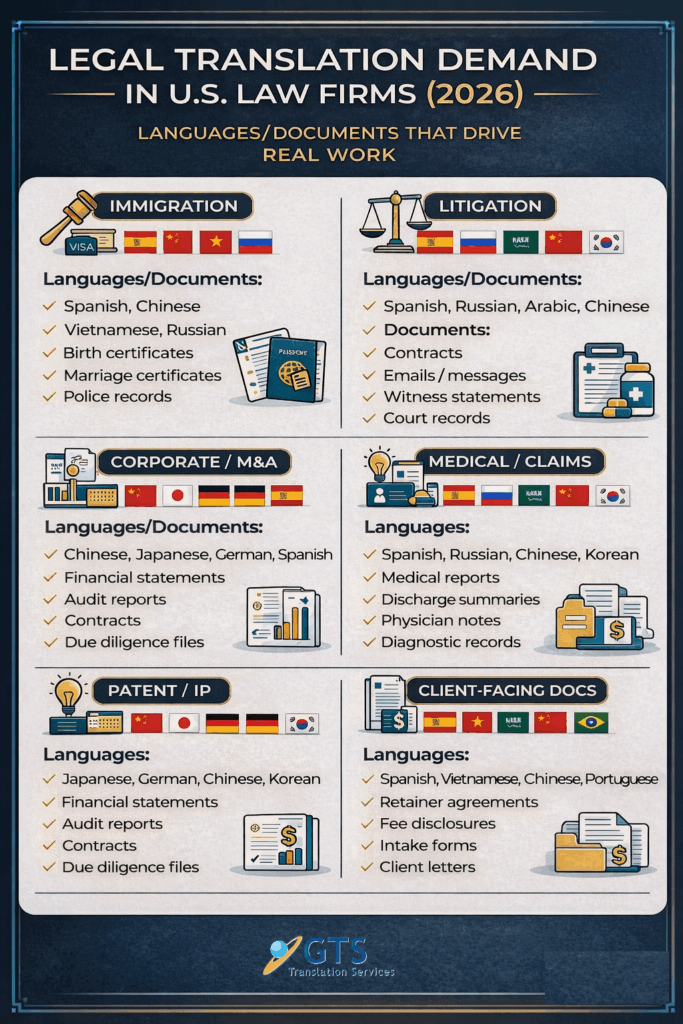
1. Immigration and Personal Civil Documents
One of the highest-volume categories is translation into English of personal civil documents for immigration and related legal matters. Common source languages include Spanish, Chinese, Vietnamese, Russian, Arabic, and Korean.
Typical documents include:
- Birth certificates
- Marriage certificates
- Divorce decrees
- Household or family registry documents
- Police records
- Academic transcripts and diplomas
These materials are frequently needed for USCIS filings, consular matters, family petitions, asylum matters, adjustment of status cases, and naturalization support documents. In many firms, this type of work represents a steady, recurring translation need rather than a one-off request.
2. Litigation and Foreign-Language Evidence
Litigation is another major driver of legal translation demand into English. When evidence exists in a foreign language, counsel may need certified or professionally prepared translations for review, motion practice, discovery, deposition preparation, or court submission.
Common source languages include Spanish, Russian, Arabic, Chinese, and Korean.
Typical documents include:
- Contracts and amendments
- Email chains and business correspondence
- Witness statements and declarations
- Police reports
- Court documents from foreign jurisdictions
- Text messages and social media evidence
This is one of the most sensitive areas of legal translation because inaccuracies can affect case strategy, admissibility, credibility, and settlement posture. Foreign-language evidence is only useful to counsel and the court if it can be understood in reliable English.
3. Medical Records for Personal Injury, Insurance, and Malpractice Matters
Medical records are a substantial but often under-discussed source of translation work for law firms. In personal injury litigation, insurance disputes, disability claims, and malpractice cases, firms may need medical documentation translated into English so attorneys, experts, adjusters, and courts can evaluate the record.
Common source languages include Spanish, Russian, Chinese, Korean, Arabic, and Portuguese.
Typical documents include:
- Hospital discharge summaries
- Diagnostic reports
- Operative reports
- Physician notes
- Prescription and treatment histories
- Medical certificates and assessments
In these matters, translation is not merely administrative. It directly affects the ability to assess causation, injury severity, continuity of treatment, and damages.
4. Corporate, Financial, Audit, and M&A Documents
Cross-border corporate work creates consistent demand for legal translation into English, especially where U.S. counsel represents buyers, investors, lenders, or counterparties reviewing foreign-language documentation. A particularly important language pair in this area is Chinese to English, although Japanese, German, Korean, Portuguese, Spanish, and French also arise regularly.
Typical documents include:
- Financial statements
- Audit reports
- Due diligence materials
- Shareholder agreements
- Commercial contracts
- M&A transaction documents
- Corporate records and resolutions
For U.S. law firms, this work is often time-sensitive and commercially significant. The need is not just to translate words, but to allow legal teams to review risk, structure, obligations, and representations in English as part of a larger transaction.
5. Patent and Intellectual Property Translation
Patent translation is a major category of legal translation and deserves separate treatment. Intellectual property practices routinely work with foreign-language technical and legal documents that must be translated either into English for U.S. use or into another national language for foreign filing.
Key source languages often include Japanese, German, Chinese, and Korean.
Typical documents include:
- Patent specifications
- Claims
- Abstracts
- Office actions
- Prior art references
- Technical exhibits and supporting documents
Law firms may need patent translation for USPTO filings, foreign national phase entry, international patent strategy, infringement disputes, and prior art analysis. Because patents combine legal and technical language, this is one of the most specialized segments of legal translation.
6. Family Law: Prenups, Divorce, and Custody Materials
Family law also generates meaningful translation demand, especially in matters involving international marriages, foreign judgments, overseas assets, and multilingual families. Common source languages include Spanish, Russian, Chinese, Korean, and Portuguese.
Typical documents include:
- Prenuptial and postnuptial agreements
- Divorce decrees
- Custody rulings
- Financial disclosures
- Marriage certificates
- Foreign court orders
In these matters, translation can be central to issues of marital status, enforceability, support, custody, and asset tracing.
7. Client-Facing Legal Documents: Fee Agreements, Disclosures, and Intake Materials
Not all legal translation is evidentiary or filing-related. Many law firms also need clear translations of client-facing documents so prospective or existing clients can understand the legal relationship and core terms of representation.
Common target languages include Spanish, Vietnamese, Chinese, Korean, and Portuguese.
Typical documents include:
- Retainer agreements
- Fee agreements
- Conflict disclosures
- Authorization forms
- Intake questionnaires
- Settlement summaries and explanatory letters
This category is especially relevant for firms serving multilingual communities. In practice, firms often need these documents translated not because a court requires it, but because client communication, informed consent, and risk management require it.
When Law Firms Need Translation from English into Other Languages
While translation into English dominates many legal workflows in the United States, a significant portion of legal translation demand flows in the opposite direction. Law firms frequently need to translate English-language documents into foreign languages for client communication, cross-border transactions, regulatory compliance, and international legal proceedings.
1. Client Communication in Multilingual Markets
Law firms serving diverse populations often translate key documents into languages their clients understand. In the U.S., this most commonly includes Spanish, but also Chinese, Vietnamese, Korean, and Portuguese.
Typical documents include:
- Retainer and fee agreements
- Settlement summaries
- Client advisories and legal notices
- Intake forms and questionnaires
Clear communication in a client’s native language is often essential for informed consent, risk management, and client satisfaction.
2. Cross-Border Corporate and Regulatory Work
In international transactions, U.S. law firms often need English documents translated into other major business languages, including French, German, Spanish, Chinese, Japanese, and Korean.
Typical documents include:
- Commercial agreements
- Compliance and regulatory filings
- Corporate policies and governance documents
- Due diligence summaries
These translations support foreign subsidiaries, regulators, counterparties, and local counsel.
3. Patent and Intellectual Property Filings Abroad
Patent practices routinely translate English-language filings into foreign languages for national phase entry and international protection.
Common target languages include German, French, Japanese, Chinese, and Korean.
Accuracy is critical because translation errors can affect scope of protection, enforceability, and prosecution outcomes.
4. Employment, Compliance, and Internal Documentation
Companies operating internationally often require legal documents translated for employees and regulators in multiple jurisdictions.
Typical documents include:
- Employee handbooks
- Codes of conduct
- HR policies and training materials
- Regulatory compliance documentation
In these cases, translation supports legal compliance, workforce communication, and operational consistency across markets.
Top Language Pairs by Legal Use Case
| Use Case | Common Language Pairs | Typical Documents |
|---|---|---|
| Immigration and civil records | Spanish to English, Chinese to English, Vietnamese to English | Birth certificates, marriage certificates, diplomas, police records |
| Litigation and evidence | Spanish to English, Russian to English, Arabic to English | Contracts, emails, witness statements, court records |
| Medical records and claims | Spanish to English, Russian to English, Chinese to English | Hospital records, physician notes, diagnostic reports |
| Corporate, financial, and M&A | Chinese to English, Japanese to English, German to English | Audit reports, financial statements, agreements, due diligence files |
| Patent and IP | Japanese to English, German to English, Chinese to English | Patent specifications, claims, office actions, prior art |
| Family law | Spanish to English, Russian to English, Korean to English | Prenups, divorce decrees, custody rulings, financial disclosures |
| Client-facing legal documents | English to Spanish, English to Vietnamese, English to Chinese | Fee agreements, disclosures, intake forms, letters |
Why Language Demand in Law Firms Is Not One-Size-Fits-All
A law firm handling high-volume immigration matters may see mostly Spanish to English civil documents. A firm doing cross-border corporate work may see more Chinese to English contracts and audit reports. An IP practice may work repeatedly with Japanese, German, and Chinese patent materials. A plaintiff-side practice may need foreign-language medical records. A community-based firm may need retainer agreements and disclosures translated into Spanish or Vietnamese.
That is why legal translation demand is best understood not as a generic language ranking, but as a set of recurring legal scenarios tied to specific document types.
How Law Firms Buy Translation Services
Law firms typically look for three things when ordering translation:
- Speed for urgent filings, hearings, deal timelines, and discovery deadlines
- Reliability for documents that may be scrutinized by courts, agencies, counterparties, or clients
- Clear pricing so attorneys and staff can quickly estimate cost before sending files out
For that reason, many firms prefer to work with translation providers that offer a fast quote tool and a streamlined ordering process. In busy legal environments, the ability to obtain a quick estimate and place an order online can matter almost as much as the translation itself.
Methodology
This overview is based on recurring legal translation use cases observed by GTS Translation Services across immigration, litigation, family law, intellectual property, medical-legal, and cross-border corporate matters. The emphasis is not on abstract language popularity, but on the document types and legal scenarios that most often generate translation demand for U.S. law firms.
Professional Legal Translation Services for Law Firms
GTS Translation Services provides legal translation in over 100 languages, including certified translations accepted by courts, government agencies, law firms, and corporate legal departments. We regularly handle translation of civil records, contracts, litigation materials, medical records, patent documents, and client-facing legal documents.
For law firms, the real issue is usually not whether translation is needed, but which documents need it, in which language pair, and how fast a reliable estimate can be obtained.