Inside Miami’s Rise as the Gateway to Latin America
Few cities in the United States have developed such deep economic ties with Latin America as Miami. Over the past several decades, the city has evolved from a regional tourism destination into one of the most important international business centers in the Western Hemisphere.
Today Miami serves as a commercial bridge connecting the United States with Latin America and the Caribbean. Multinational corporations, financial institutions, logistics companies, and technology firms frequently manage regional operations from offices in South Florida.
A Strategic Geographic Location
Miami’s rise as an international business hub is partly geographic. Located at the southern edge of the United States, the city sits closer to many Latin American capitals than to major American business centers such as New York or Chicago.
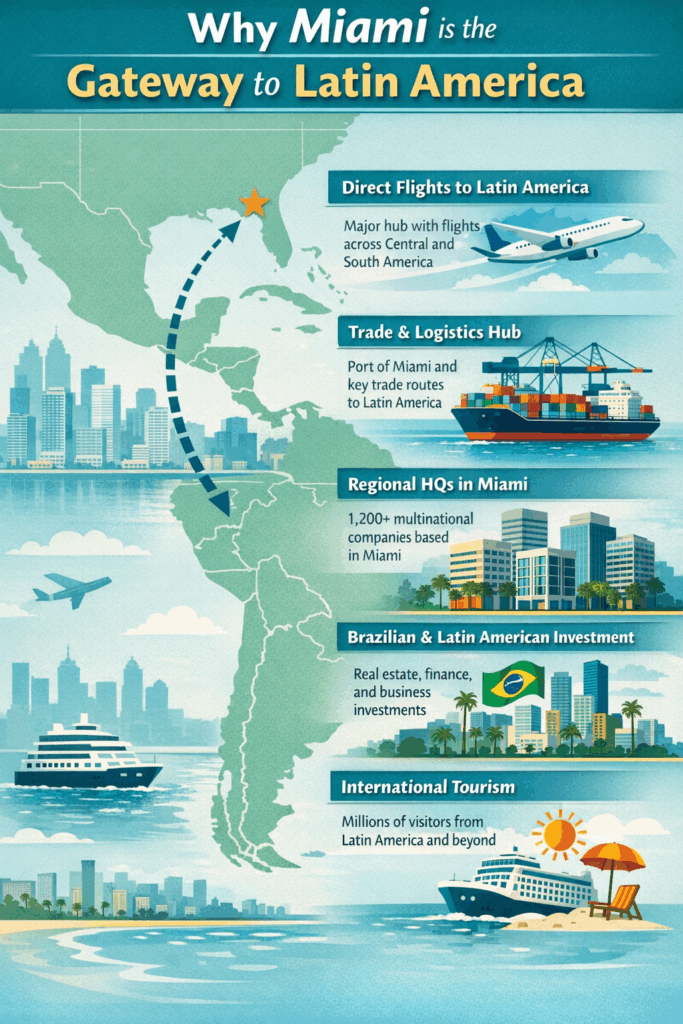
Flights from Miami connect directly to dozens of cities across Central America, South America, and the Caribbean, making it a natural headquarters for companies managing cross-border operations.
Miami International Airport is consistently ranked among the busiest U.S. airports for international cargo and passenger traffic to Latin America. This connectivity allows executives, investors, and professionals to move quickly between markets.
A Regional Headquarters for Global Companies
Many multinational companies manage their Latin American operations from Miami, including firms such as Microsoft, Oracle, Canon, Caterpillar, DHL and PepsiCo. The presence of these global companies reflects the city’s role as one of the most important commercial bridges between the United States and Latin America.
More than 1,200 multinational companies operate their Latin American headquarters in Miami-Dade County, reflecting the city’s role as a commercial bridge between the United States and Latin America.
This concentration of international business activity has created a diverse professional ecosystem that includes law firms, accounting firms, financial institutions, consulting companies, and international trade specialists.
The Wall Street of the South
Brickell, located just south of Downtown Miami, has developed into the city’s primary financial district and is often referred to as the “Wall Street of the South.” The area is home to a dense concentration of international banks, investment firms, and regional headquarters serving Latin American markets. Major financial institutions from the United States, Europe, and Latin America maintain offices in Brickell, making it one of the most important centers for cross-border finance in the Western Hemisphere. The district’s modern skyline of office towers, luxury residences, and international business hubs reflects Miami’s growing role as a gateway for global commerce.
Strong Trade and Logistics Infrastructure
The Port of Miami, often called the “Cruise Capital of the World,” is also a major cargo gateway connecting the United States with markets throughout the Caribbean and Latin America. The port handles billions of dollars in international trade each year.
Combined with Miami International Airport and the region’s extensive logistics infrastructure, the city has become one of the most important transportation and distribution hubs for goods moving between North and South America.
Brazilian and Latin American Investment
Miami has also become a major destination for Latin American investment. Brazilian, Colombian, Argentine, and Mexican investors have played a significant role in the city’s real estate, finance, and technology sectors.
In particular, Brazilian investment has transformed parts of the South Florida real estate market. Miami is now considered one of the primary international destinations for Brazilian companies expanding into the United States.
Tourism and Cultural Connections
Tourism continues to play an important role in Miami’s economy. Millions of visitors arrive every year from Latin America, Europe, and around the world.
These international connections have shaped Miami into one of the most multicultural cities in North America, where Spanish, English, and Portuguese are commonly heard in business, hospitality, and everyday life.
International Business Requires Multilingual Communication
As Miami’s international economy continues to grow, companies operating across borders frequently rely on multilingual communication for contracts, financial reporting, marketing materials, and regulatory documentation.
Organizations seeking professional Miami translation services often work with language providers experienced in supporting international trade, finance, and legal documentation across multiple languages.